Der Shop ist online

Wir bauen Workstation AI-Maschinen für Websites, KI-Agenten und LLM-Training – online konfigurieren und kaufen.

Händlerpreise erhalten
KI-Produkte
KI-LabsOpenAI-AgentenClaude-AgentenGrok-BotWorkstation AI-natives CRMMarketingAlle Produkte
KI-Lösungen
Angewandte KIKI-AgentenGenerative KIKI-AutomatisierungKI-WeiterbildungKI-Pakete für KMUEnterprise AI LabKI-WorkstationsNVIDIA-Hardware & -SoftwareNVIDIA Accelerated ComputingPrivate KIGPU-Private-CloudGPU-ClusterEdge-KIKI nach Branche
KI-Services
PlattformmodernisierungDigital EngineeringDatengrundlagen & KIAutonomer BetriebKI-BeratungDevOps-AutomatisierungCybersicherheitSoftwareentwicklungAgentenentwicklungMLOps-EinrichtungGPU-LeasingGPU-Private-Cloud
Über uns
UnternehmenUnsere GeschichtePartnerKundengeschichten
KI-Rechenzentren
KI-RechenzentrenGPU-Private-CloudGPU-ClusterGPU-Leasing
KI-EinblickeJev-ReiheBenchmark LabModellauswahl
Technische Hinweise
Dokumentation
Linux-BetriebssystemeUbuntuRed Hat Enterprise LinuxSUSE LinuxAlpine LinuxDebian, Rocky & AlmaLinux
KI-Cloud-PlattformenAWS & Amazon BedrockGoogle Cloud & Vertex AIMicrosoft Azure & AI FoundryGPU-Clouds & Marktplätze
Private KI-RechenzentrenFür AnwaltskanzleienFür Steuer- und WirtschaftsprüfungskanzleienOn-Premises-PlattformenVollständig abgesicherte Cloud
ToolsRing PromoterJobshout
News
Blog
KontaktAnmelden

KI-Workstations, Multi-Agenten-KI-Software, GPU-Infrastruktur und intelligente Agentenlösungen für moderne Unternehmen.

Kontakt

KI-Lösungen

Angewandte KIKI-AgentenGenerative KIKI-AutomatisierungKI-WeiterbildungKI-Pakete für KMUEnterprise AI LabKI nach Branche

Produkte

Alle ProdukteWorkstation AI-natives CRM & ERPMarketingOpenAI-AgentenRing PromoterJobshout

Unternehmen

Über unsUnternehmenKI-RechenzentrenWarum WorkstationPartnerKundengeschichtenPreiseKontaktTenthMatrix

Ressourcen

KI-EinblickeTechnische HinweiseDokumentationLinux-BetriebssystemeKI-Cloud-PlattformenPrivate KI-RechenzentrenBlogSucheSitemap
Büro Belgien
Workstation SRL, Rue Vanderkindere 34, 1180 Uccle, BrusselsBE 0751.518.683Mo – Fr: 9:00 – 18:00 Uhr MEZ
+32 492 45 67 46
Hauptsitz Großbritannien
77-79 Marlowes, Hemel Hempstead HP1 1LFAnfahrt – Ausfahrt 20 der M25 (Outer London)Handelsregisternr.: 11641870Mo – Fr: 9:00 – 18:00 Uhr GMT
+44 7515 356 146
Büro Indien
#159 Sector 9, Pocket 1, DDA Flats, 110077 Dwarka, New Delhi
+91 98881 98841
Büro Taiwan
3F, No. 2-4, Aisi Rd., Ren'ai Dist., Keelung City 200, Taiwan基隆市仁愛區愛四路2之4號3樓Mo – Fr: 9:00 – 18:00 Uhr Taiwan-Zeit (GMT+8)
+886 926 892 701+32 492 45 67 46
Büro Estland
Aleksander Puškini tn 30-25, 20306 Narva, EstoniaMo - Fr: 9:00 - 18:00 Uhr estnischer Zeit (EET)
+32 492 45 67 46

© 2026 Workstation AI. Alle Rechte vorbehalten.

DatenschutzDatenlöschungCookiesNutzungsbedingungenWebsite-Sitemap

NVIDIA, das NVIDIA-Logo, RTX, RTX PRO, Blackwell, CUDA, NVLink, MGX, Omniverse, Spectrum-X, Quantum, BlueField, DGX und HGX sind Marken und/oder eingetragene Marken der NVIDIA Corporation in den USA und anderen Ländern. AMD, das AMD-Arrow-Logo, EPYC, Instinct, Ryzen und Threadripper sind Marken von Advanced Micro Devices, Inc. Dell und PowerEdge sind Marken der Dell Inc. oder ihrer Tochtergesellschaften. Intel und Xeon sind Marken der Intel Corporation oder ihrer Tochtergesellschaften. AMAX, AceleMax und LiquidMax sind Marken der AMAX Engineering Corporation. Alle anderen Produktnamen, Logos und Marken sind Eigentum ihrer jeweiligen Inhaber. Wir verwenden sie ausschließlich, um die Produkte zu kennzeichnen, die wir beschreiben, liefern oder unterstützen; ihre Verwendung bedeutet nicht, dass ihre Inhaber uns empfehlen.

Startseite / Technische Hinweise / Technology
DevOpsSecurityAISRE

WSLVault: Why AI Agents Need Cryptographic Secrets Isolation

Technical brief: why agentic systems raise the stakes for secret lifecycle, cosmetic tenant filters vs cryptographic refusal, envelope keys, leases, and video chapters

24. September 2026Technology4 min read

Long-form companion to the blog. For platform and security architects shipping AI agents on shared infrastructure: why secret lifecycle is non-negotiable, and why isolation must be cryptographic — not a WHERE clause. Product: Workstation WSL Vault · wslvault.org · GitHub.
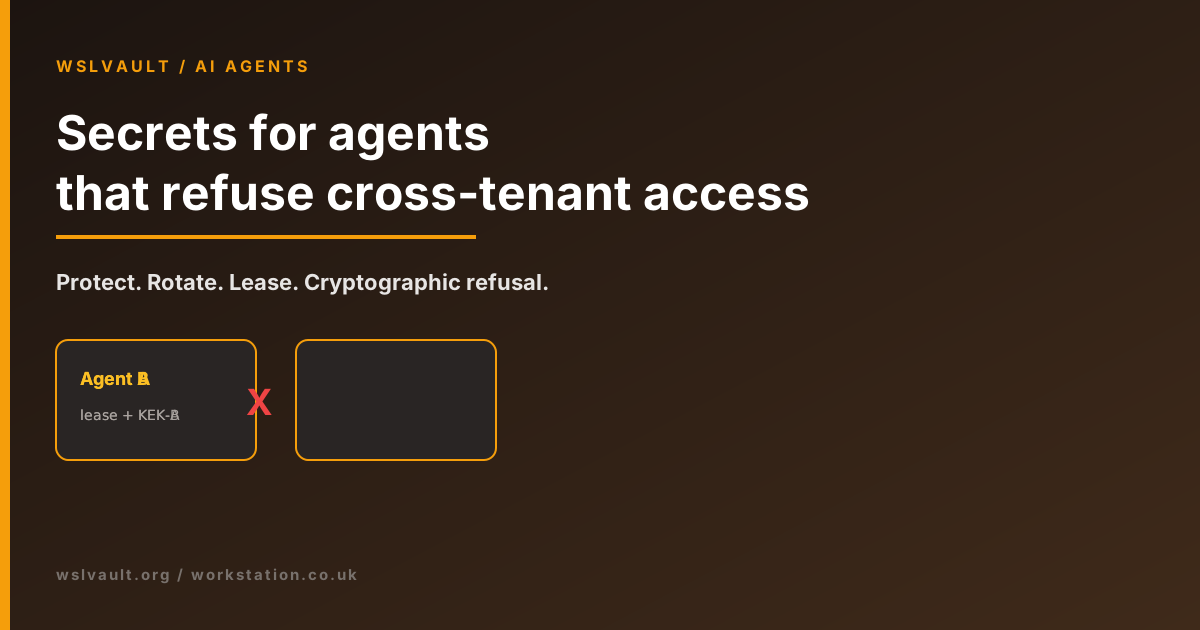
WSLVault — AI agents and cryptographic secrets isolation

~20 min — youtu.be/O6q3_H0k2M8 · same recording angled for tenancy

Thesis. AI agents amplify every secrets mistake: they call tools at machine speed, keep credentials across loops, and often share multi-tenant platforms. Protecting, rotating, and managing secrets is therefore more critical for agents than for classic services — and isolation that depends only on application filters is not isolation.

1. Why protecting, rotating, and managing secrets is even more critical for AI agents

Classic apps usually fetch a small set of credentials at startup. Agents are different:

  • Tool sprawl — one session may need cloud APIs, databases, ticketing, email, and MCP servers. Each credential is a live capability, not a config value.
  • Session persistence — keys sitting in env files, chat context, or MCP configs outlive a single request. Without rotation and leases, compromise windows stay open.
  • Autonomous action — once an agent holds a token, it will use it. There is no “wait for the human to notice” between leak and abuse.
  • Multi-tenant agent platforms — Team A’s agent and Team B’s agent may share schedulers, storage, and observability. A bug or a stolen database dump must never hand one tenant the other’s plaintext.
  • Compliance and audit — regulators and customers ask who accessed which secret, for which agent, and whether the trail can be tampered with.

That is why the control set for agents is stricter: protect (envelope encryption at rest), rotate (KEK/DEK and static roles on a period), and manage (identity-bound policies, short-lived leases, real revoke).

Agent digest. (1) Never put long-lived secrets in agent prompts or MCP config files. (2) Issue dynamic credentials with TTL; renew near expiry; revoke on stop. (3) Bind identity per tenant and per agent workload. (4) Assume shared infrastructure — require cryptographic tenant isolation, not cosmetic tenant IDs.

2. Why tenant IDs alone are cosmetic isolation

Most “multi-tenant vaults” isolate with application filters: WHERE tenant_id = ?. That fails closed only if every code path is perfect forever — including backups, analytics jobs, support tools, and the next junior PR.

When Team A and Team B share a platform, ask: can a bug or a stolen database dump ever hand one team the other’s plaintext? If the answer depends on a filter, the answer is yes.
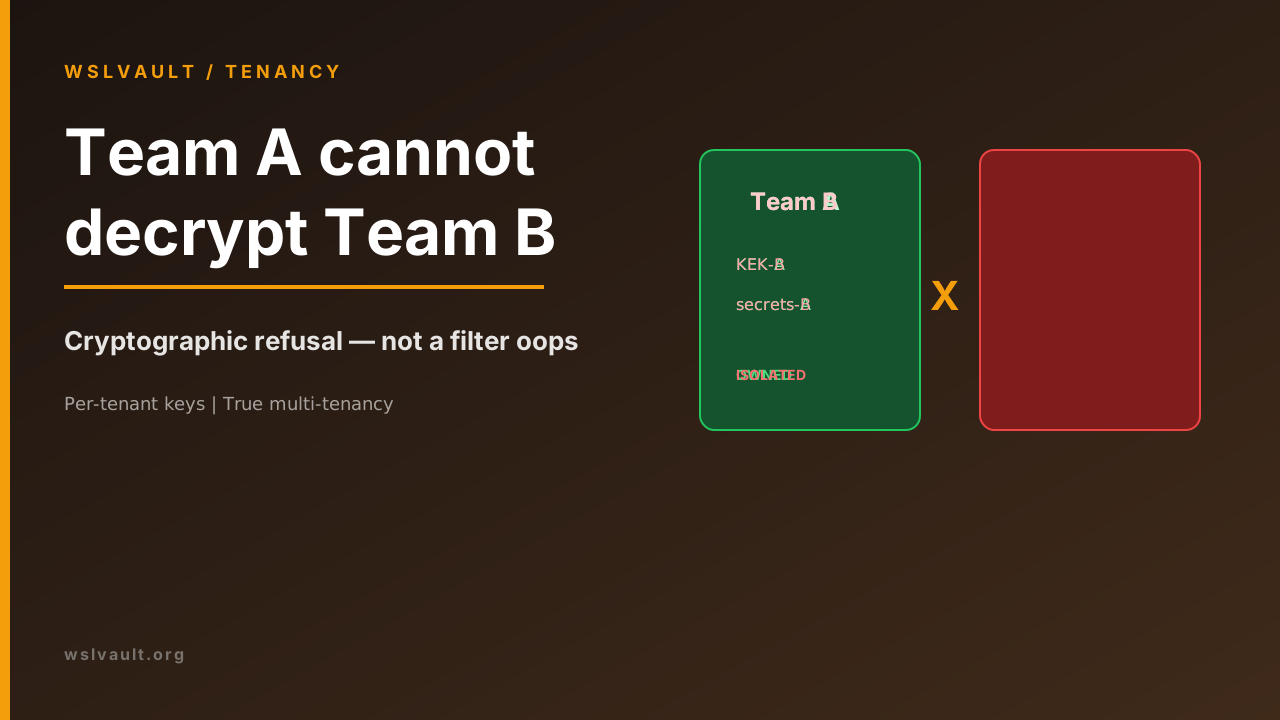
Team A cannot decrypt Team B

3. Cryptographic refusal — WSLVault’s answer

WSLVault seals every secret before storage under a per-tenant hierarchy: DEK → tenant KEK → root KEK (KMS / HSM / Shamir). Each data key belongs to exactly one tenant. A cross-tenant request returns not found, not another tenant’s row with the wrong label.

That is cryptographic refusal: Team A cannot decrypt Team B even if an upper layer misroutes an identifier. Isolation holds at the crypto service — the place filter bugs cannot quietly rewrite.
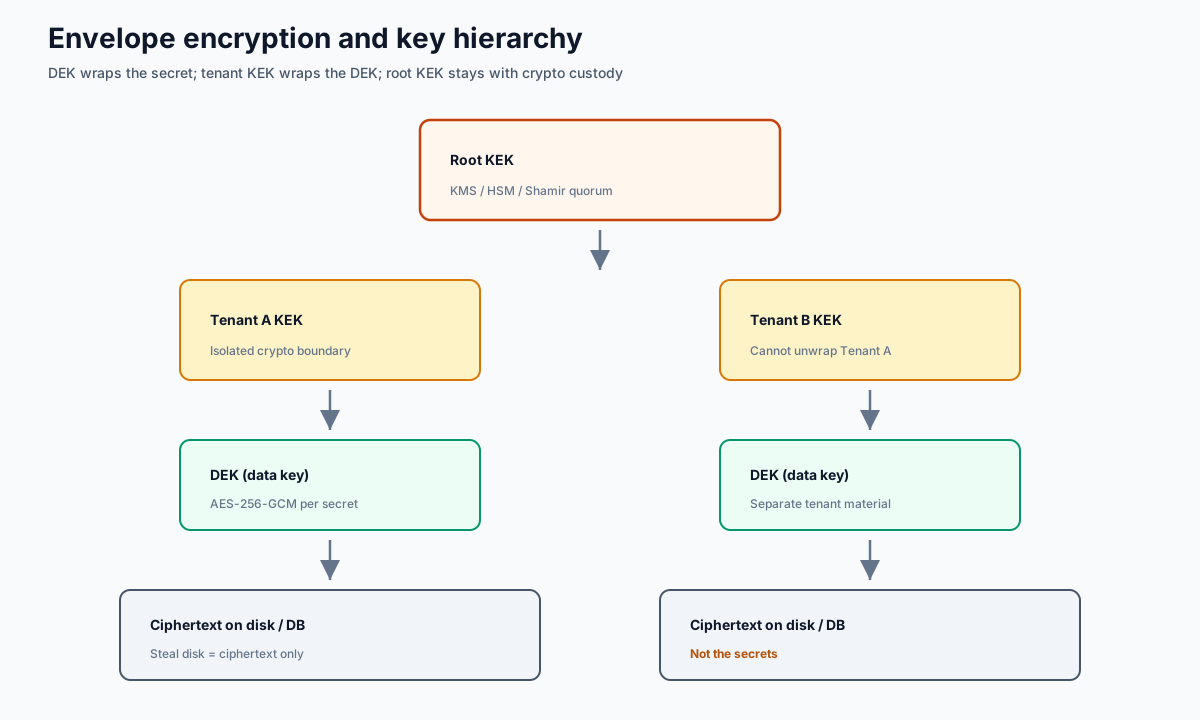
WSLVault envelope encryption key hierarchy

4. Engines still work per tenant

Isolation does not mean you lose Vault-compatible workflows. Per tenant you still get:

Engine Why agents care
KV v2Versioned config and API material sealed before disk — not plaintext beside the agent runtime
TransitEncrypt/decrypt/sign without exporting keys into the model or tool process
PKIShort-lived certs for mTLS between agent, MCP, and backends
LeasesDynamic credentials with renew/revoke — stop the agent, kill the access

5. Protect → rotate → manage (agent checklist)

  1. Protect — envelope encryption; root custody outside the data plane; no plaintext in backups or audit payloads.
  2. Rotate — rotate tenant KEKs and static roles on a period; keep old ciphertext readable via transit versioning where needed.
  3. Manage — identity-bound tokens (not trusted headers alone), fine-grained policies, MFA for operators, leases with real revoke for agent sessions.
  4. Prove — tamper-evident, hash-chained audit per tenant so you can show who did what without storing secrets in the trail.
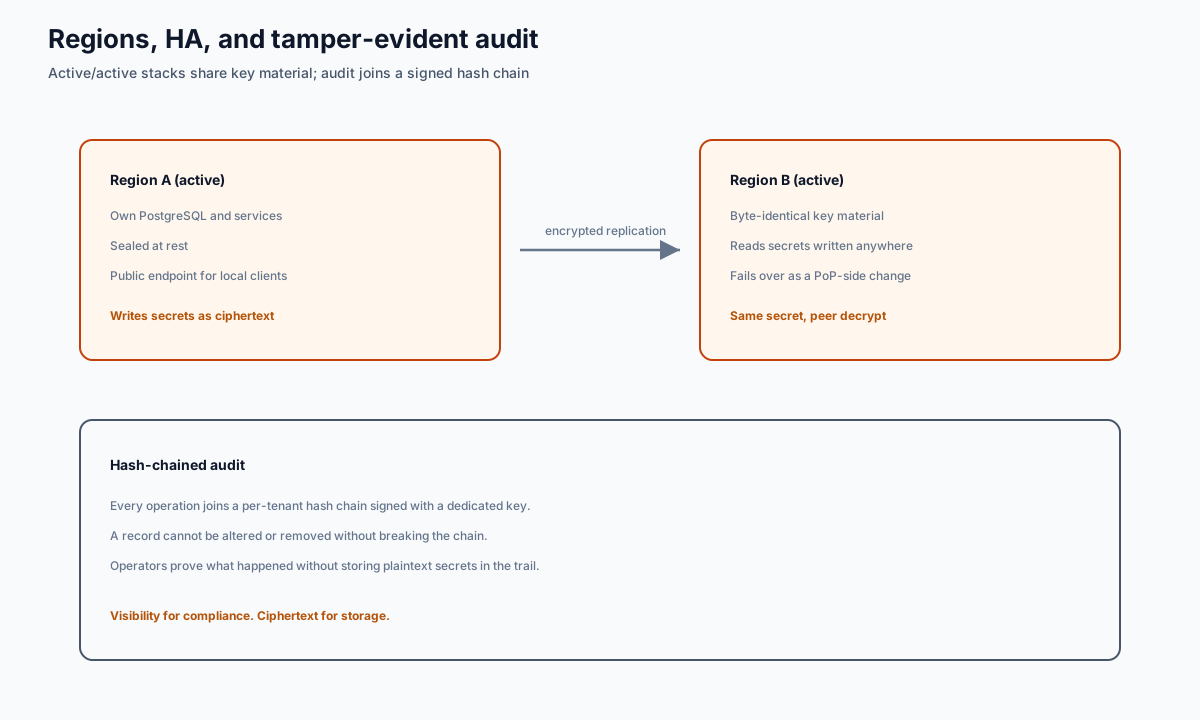
WSLVault multi-region and tamper-evident audit

6. Video chapters

Time Topic
0:00Why this matters (steal the server)
1:30What WSLVault is
3:00Envelope encryption and key hierarchy
5:30Multi-tenancy that actually isolates
8:00Console walkthrough (secrets, transit, PKI)
11:00Identity, policies, leases and MFA
14:00Regions, HA and audit
17:00Deploy on Kubernetes
19:00Where to go next

7. Where to go next

  • Site: https://www.wslvault.org/
  • GitHub: https://github.com/bwalia/wslvault
  • Getting started: GETTING-STARTED.md
  • Workstation product page: /en/wsl-vault
  • Intro brief: Steal the server. Not the secrets.
  • Related: Agentic AI security — MCP, OAuth, Vault leases

Published by Workstation.
Diesen Artikel teilen

Mehr zu Technology

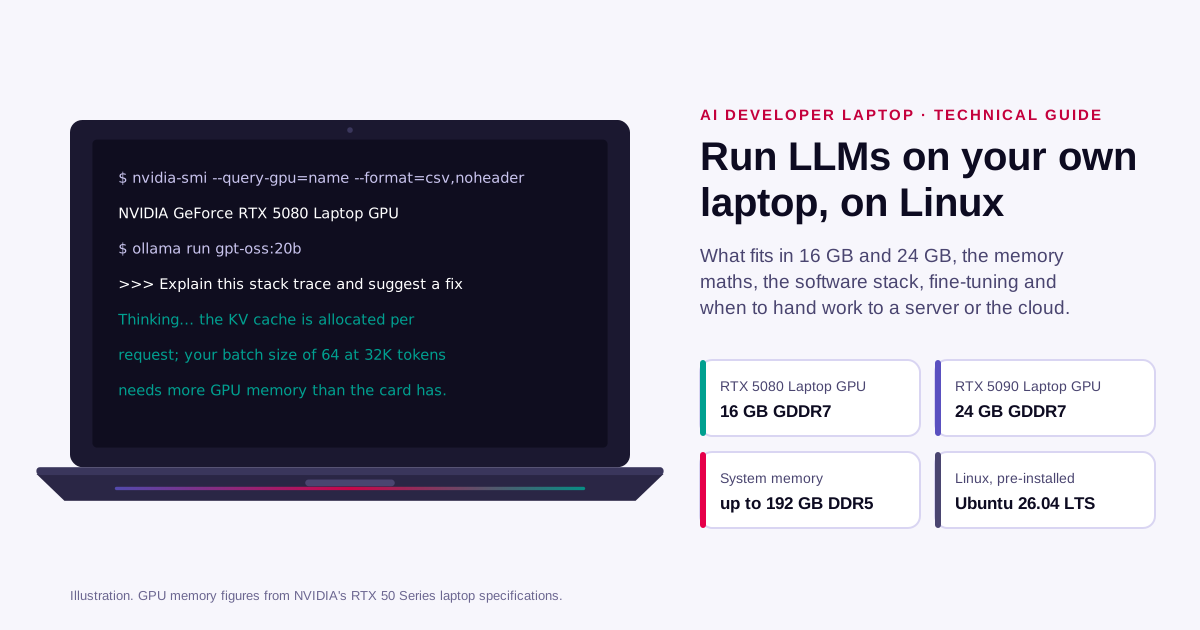
Laptops für KI-Entwickler: LLMs lokal unter Linux mit GPUs mit 16 GB und 24 GB betreiben (Leitfaden 2026)

Laptops für KI-Entwickler: LLMs lokal unter Linux mit GPUs mit 16 GB und 24 GB betreiben (Leitfaden 2026)

Was auf eine RTX 5080 oder RTX 5090 Laptop GPU passt, die Speicherrechnung, die lohnenden offenen Modelle, die Einrichtung von Ubuntu 26.04 mit dem NVIDIA-Stack, Ollama, llama.cpp und vLLM, Coding-Assistenten, LoRA-Fine-Tuning, Sicherheit und wann Arbeit auf einen Server gehört

Weiterlesen
ML- und LLM-Systeme testen, deren Korrektheit sich nicht beweisen lässt: ein Python-Evidenz-Kit

ML- und LLM-Systeme testen, deren Korrektheit sich nicht beweisen lässt: ein Python-Evidenz-Kit

Evidenz statt Beweise, in etwa 400 Zeilen Python mit echter Ausgabe: Slice-Metriken mit Bootstrap-Intervallen und einem Pass/Fail-Vertrag, Property- und metamorphe Tests mit Hypothesis, Kalibrierung und Conformal Prediction, Pydantic-Verträge und Regressionsevaluierungen für LLM-Ausgaben, Drift-Prüfungen, ein CI-Gate und die exakte Verifikation eines kleinen neuronalen Netzes

Weiterlesen
TorchCurves in der Praxis: lernbare B-Spline- und Legendre-Kurven in PyTorch

TorchCurves in der Praxis: lernbare B-Spline- und Legendre-Kurven in PyTorch

torchcurves installieren, eine Kurve anpassen und dimensionieren, B-Spline oder Legendre und die Eingabeabbildung wählen, eine monotone Kalibrierungskurve und ein additives Modell auf tabellarischen Daten bauen, mit SciPy, scikit-learn, einem KAN und einem MLP vergleichen, Koeffizienten nach JSON exportieren, testen und in der Produktion betreiben, mit echten Ausgaben

Weiterlesen