Der Shop ist online

Wir bauen Workstation AI-Maschinen für Websites, KI-Agenten und LLM-Training – online konfigurieren und kaufen.

Händlerpreise erhalten
KI-Produkte
KI-LabsOpenAI-AgentenClaude-AgentenGrok-BotWorkstation AI-natives CRMMarketingAlle Produkte
KI-Lösungen
Angewandte KIKI-AgentenGenerative KIKI-AutomatisierungKI-WeiterbildungKI-Pakete für KMUEnterprise AI LabKI-WorkstationsNVIDIA-Hardware & -SoftwareNVIDIA Accelerated ComputingPrivate KIGPU-Private-CloudGPU-ClusterEdge-KIKI nach Branche
KI-Services
PlattformmodernisierungDigital EngineeringDatengrundlagen & KIAutonomer BetriebKI-BeratungDevOps-AutomatisierungCybersicherheitSoftwareentwicklungAgentenentwicklungMLOps-EinrichtungGPU-LeasingGPU-Private-Cloud
Über uns
UnternehmenUnsere GeschichtePartnerKundengeschichten
KI-Rechenzentren
KI-RechenzentrenGPU-Private-CloudGPU-ClusterGPU-Leasing
KI-EinblickeJev-ReiheBenchmark LabModellauswahl
Technische Hinweise
Dokumentation
Linux-BetriebssystemeUbuntuRed Hat Enterprise LinuxSUSE LinuxAlpine LinuxDebian, Rocky & AlmaLinux
KI-Cloud-PlattformenAWS & Amazon BedrockGoogle Cloud & Vertex AIMicrosoft Azure & AI FoundryGPU-Clouds & Marktplätze
Private KI-RechenzentrenFür AnwaltskanzleienFür Steuer- und WirtschaftsprüfungskanzleienOn-Premises-PlattformenVollständig abgesicherte Cloud
ToolsRing PromoterJobshout
News
Blog
KontaktAnmelden

KI-Workstations, Multi-Agenten-KI-Software, GPU-Infrastruktur und intelligente Agentenlösungen für moderne Unternehmen.

Kontakt

KI-Lösungen

Angewandte KIKI-AgentenGenerative KIKI-AutomatisierungKI-WeiterbildungKI-Pakete für KMUEnterprise AI LabKI nach Branche

Produkte

Alle ProdukteWorkstation AI-natives CRM & ERPMarketingOpenAI-AgentenRing PromoterJobshout

Unternehmen

Über unsUnternehmenKI-RechenzentrenWarum WorkstationPartnerKundengeschichtenPreiseKontaktTenthMatrix

Ressourcen

KI-EinblickeTechnische HinweiseDokumentationLinux-BetriebssystemeKI-Cloud-PlattformenPrivate KI-RechenzentrenBlogSucheSitemap
Büro Belgien
Workstation SRL, Rue Vanderkindere 34, 1180 Uccle, BrusselsBE 0751.518.683Mo – Fr: 9:00 – 18:00 Uhr MEZ
+32 492 45 67 46
Hauptsitz Großbritannien
77-79 Marlowes, Hemel Hempstead HP1 1LFAnfahrt – Ausfahrt 20 der M25 (Outer London)Handelsregisternr.: 11641870Mo – Fr: 9:00 – 18:00 Uhr GMT
+44 7515 356 146
Büro Indien
#159 Sector 9, Pocket 1, DDA Flats, 110077 Dwarka, New Delhi
+91 98881 98841
Büro Taiwan
3F, No. 2-4, Aisi Rd., Ren'ai Dist., Keelung City 200, Taiwan基隆市仁愛區愛四路2之4號3樓Mo – Fr: 9:00 – 18:00 Uhr Taiwan-Zeit (GMT+8)
+886 926 892 701+32 492 45 67 46
Büro Estland
Aleksander Puškini tn 30-25, 20306 Narva, EstoniaMo - Fr: 9:00 - 18:00 Uhr estnischer Zeit (EET)
+32 492 45 67 46

© 2026 Workstation AI. Alle Rechte vorbehalten.

DatenschutzDatenlöschungCookiesNutzungsbedingungenWebsite-Sitemap

NVIDIA, das NVIDIA-Logo, RTX, RTX PRO, Blackwell, CUDA, NVLink, MGX, Omniverse, Spectrum-X, Quantum, BlueField, DGX und HGX sind Marken und/oder eingetragene Marken der NVIDIA Corporation in den USA und anderen Ländern. AMD, das AMD-Arrow-Logo, EPYC, Instinct, Ryzen und Threadripper sind Marken von Advanced Micro Devices, Inc. Dell und PowerEdge sind Marken der Dell Inc. oder ihrer Tochtergesellschaften. Intel und Xeon sind Marken der Intel Corporation oder ihrer Tochtergesellschaften. AMAX, AceleMax und LiquidMax sind Marken der AMAX Engineering Corporation. Alle anderen Produktnamen, Logos und Marken sind Eigentum ihrer jeweiligen Inhaber. Wir verwenden sie ausschließlich, um die Produkte zu kennzeichnen, die wir beschreiben, liefern oder unterstützen; ihre Verwendung bedeutet nicht, dass ihre Inhaber uns empfehlen.

Loading blog...

Startseite / Blogs
RustPerformanceArchitectureDevOpsAIAutomation

Rust Async Blocking, Rayon & Modern Applications

What “blocking” means in async Rust, when Rayon fits CPU-bound work, and why Rust stays strong for APIs, edge, agents, and CI/CD platforms

Balinder Walia26. August 20263 min read
Rust async blocking and Rayon for modern applications

Workstation on why Rust stays a first-class choice for modern applications — and what “blocking” really means when you mix Tokio with CPU-heavy work. Inspired by Alice Ryhl’s Async: What is blocking? (Rayon section). Deep dive: long article.

Rust async blocking and Rayon for modern applications

Bottom line. In async Rust, “blocking” means holding a runtime worker away from .await long enough that other tasks starve. Move expensive CPU work off Tokio’s pool — often with Rayon plus a oneshot channel — and keep the async path responsive for APIs, edge proxies, agents, and CI/CD control planes.

Why Rust keeps winning modern application slots

Teams pick Rust when they need memory safety without a GC pause tax, predictable latency under load, and concurrency that the type system helps you get right. That combination shows up everywhere Workstation builds: high-throughput APIs, edge gateways, agent runtimes, and promotion control planes that cannot freeze when a spike of CPU work arrives.

It is not “Rust for everything.” Our Polyglot Benchmarks dashboard and companion posts — blog / article — compare Rust with Go, Bun, JVM stacks, and scripting edges on the same HTTP workloads. Rust often leads on CPU-bound and concurrency-heavy rows; other runtimes win on velocity or edge transforms. The point is evidence, then ADRs.

What “blocking” means in async Rust

Async runtimes (Tokio and friends) swap tasks at .await points. If your task burns milliseconds of CPU or sleeps with std::thread::sleep without awaiting, the worker cannot schedule anyone else on that thread. Locally you might not notice (a few cores hide the bug); in production you run out of workers and latency tails explode.

Rule of thumb from the ecosystem: stay within tens to hundreds of microseconds between awaits for latency-sensitive services — and treat anything longer as work that belongs elsewhere.

When Rayon helps (CPU-bound)

  • spawn_blocking — Tokio’s blocking pool: great for sync IO (filesystem, blocking DB drivers); suboptimal for heavy CPU because it can oversubscribe cores.
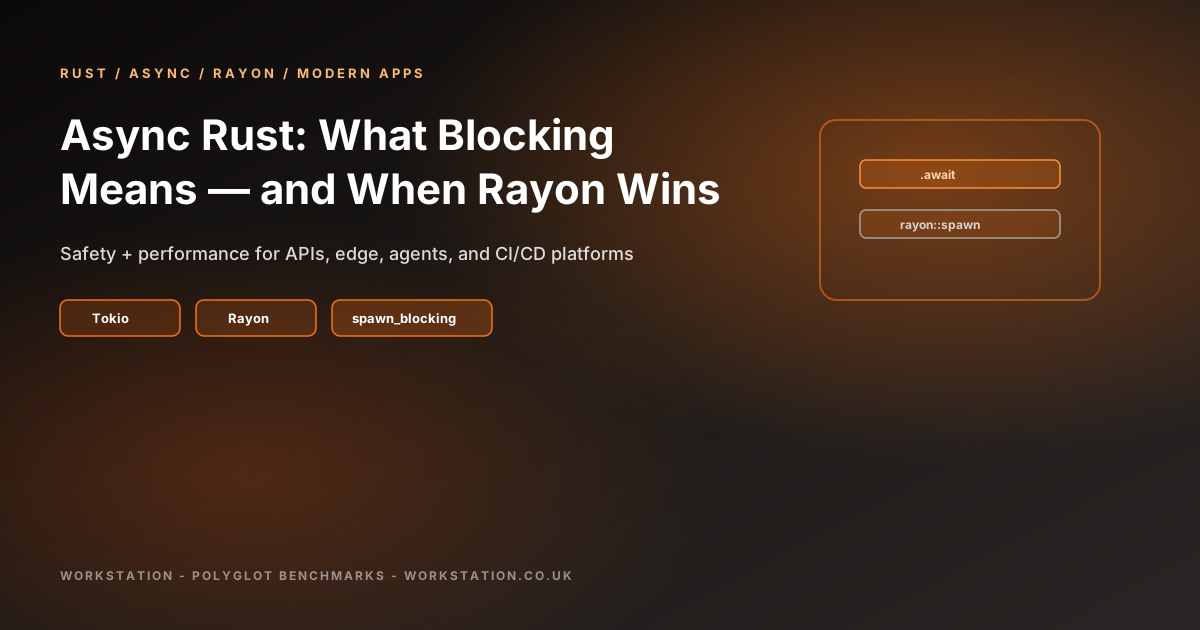
  • Rayon — a small, CPU-sized thread pool for parallel iterators and expensive computations. Bridge with rayon::spawn + tokio::sync::oneshot so the async task awaits the result without blocking the runtime thread.
  • Dedicated thread — for forever-loops (connection managers, long-lived workers) that must not permanently consume pool capacity.

That Rayon + oneshot pattern is exactly what Alice Ryhl walks through in the Rayon section — Workstation’s take is how those choices land in polyglot estates shipping agents and platforms, not a reprint of the tutorial.

Where this shows up in Workstation products

  • APIs and edge — keep request workers free for IO; fan CPU transforms onto Rayon when a hot path needs it.
  • Agents — embedding prep, eval batches, and tool-side crunch should not stall the orchestration loop.
  • CI/CD platforms — health checks and promotion engines (see Ring Promoter) stay responsive while heavier verification work runs off-pool.
  • Kubernetes ops — incident copilots like KubePilot need snappy control loops even when analysis is CPU-heavy.

Read next

  1. Long article — cheat sheet, code-shaped patterns, and architecture notes.
  2. polyglot-benchmarks.fictionally.org — live Rust vs peers evidence.
  3. Alice Ryhl — Async: What is blocking?

Published by Workstation.