RTX PRO 600 BLACKWELL SERVER EDITION: Performance vs. Compatibility

The NVIDIA RTX PRO 600 BLACKWELL SERVER EDITION is positioned as a product that accelerates professional AI, graphics, rendering and compute workloads [1]. For teams in manufacturing, supermarkets, banking, education, healthtech, fintech and tax returns, the pitch is the same: a server-class Blackwell card that promises higher throughput per rack than previous workstation parts, with a form factor aimed at on-prem AI rather than cloud-only training.
The relevance across those sectors is largely identical. A supermarket chain running demand forecasting, a bank building fraud detection, a university lab training a medical imaging model, and a tax software firm fine-tuning document classification all face the same constraints: model size vs. available memory, power and cooling budgets, and the need to run inference on-prem for data residency. The sector-specific consequences differ — a missed forecast costs shelf space, a slow inference pass delays a loan decision — but the technical trade-offs do not change.
Benefits of RTX PRO 600 BLACKWELL SERVER EDITION for AI Workloads
The primary benefit is professional AI acceleration. The product family is marketed as RTX PRO Accelerating professional AI, graphics, rendering and compute workloads [1].
Key benefits for developers:
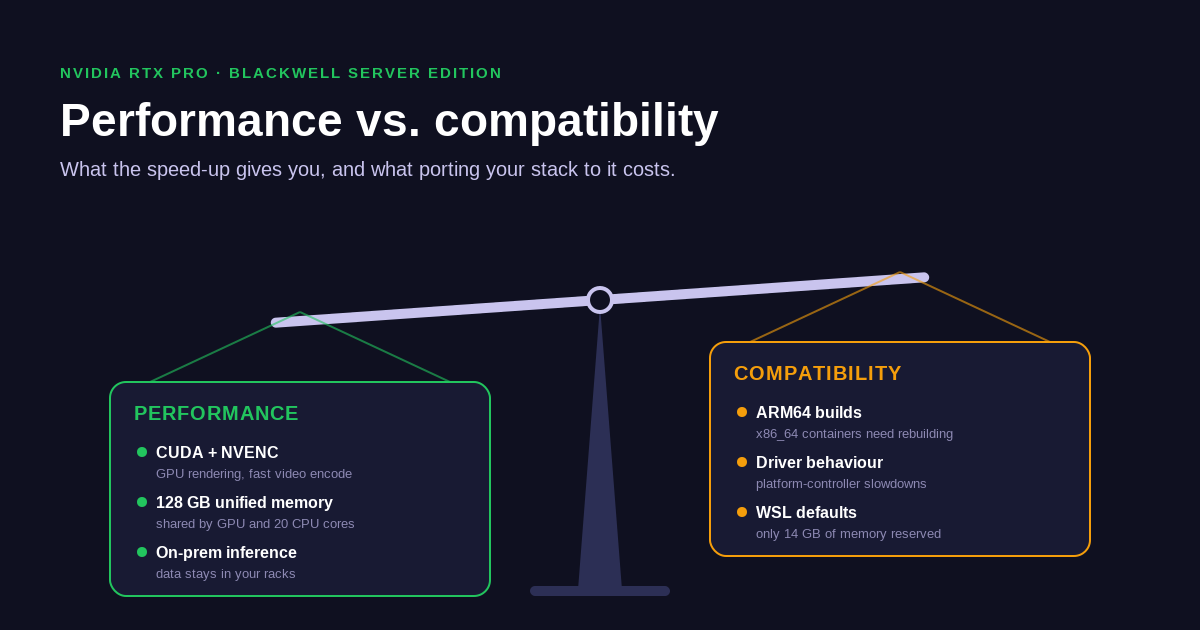
- GPU rendering support. The NVIDIA RTX PRO 600 BLACKWELL SERVER EDITION supports GPU rendering [2] and specifically supports CUDA decoding and analysis [2]. CUDA is NVIDIA’s parallel computing platform for GPU kernels; NVENC is the dedicated hardware video encoder block used for fast encode. Together they reduce preprocessing time for video-heavy pipelines.
- Unified memory on ARM64. The server edition is described as an ARM64 device [3]. ARM64 is the 64-bit ARM instruction set architecture used in many server and mobile SoCs. The referenced description notes: this is an ARM64 device with 128GB of memory that’s available to both the GPU and the 20 CPU cores at the same time, strapped onto a 4TB NVMe SSD [3]. Unified memory visibility simplifies data movement for workloads that bounce between CPU preprocessing and GPU inference.
Challenges of Using RTX PRO 600 BLACKWELL SERVER EDITION for AI Workloads
Compatibility is the dominant friction point. The ARM64 architecture noted above [3] means software stacks must be built for ARM64. Many existing AI containers, custom C extensions, and vendor libraries in manufacturing and banking are still x86_64 first. Retraining or recompiling is not a trivial cost.
Driver and platform controller behavior has historically caused performance surprises on NVIDIA RTX systems. Disabling the Nvidia Platform Controllers and Framework in Windows reproduced the slowdown in Linux [4]. That observation matters for teams mixing Windows management tools with Linux training nodes, a common setup in education labs and healthtech IT.
Windows Subsystem for Linux adds another layer. WSL runs on top of the Windows driver stack, so it inherits Windows’ full GPU boost behavior whether the laptop is plugged in or running on battery [4]. For developers prototyping on RTX Spark laptops and then moving to the server edition, this can mask power-limit differences between desktop and server environments.
Memory allocation defaults can also bite. WSL reserves only 14GB by default, which isn’t enough for large model workloads on a 128GB unified memory machine [4]. While that specific limit refers to WSL on a unified memory machine, it illustrates a broader pattern: host OS and virtualization layers can silently cap GPU-accessible memory, a problem that surfaces in supermarket edge nodes running containerized inference behind a thin host.
Figure 1. Decision flow for ARM64 binary availability on RTX PRO 600 BLACKWELL SERVER EDITION.
Performance and Efficiency Trade-Offs
Performance discussions for Blackwell PRO cards usually center on model training, model deployment, and model maintenance. The trade-off is throughput versus operational complexity.
Training benefits from high memory bandwidth and unified access, but only if the model fits and the software stack is native. Deployment favors low latency and predictable power draw. Maintenance favors stability and broad driver support.
The RTX Pro 6000, a related Blackwell PRO part, is reported with 96GB of VRAM [5] and 600W of power [5]. Those numbers illustrate the class: large VRAM budgets enable bigger models, but power draw of 600W [5] translates directly into cooling and electricity cost in a supermarket back-office or a bank data center.
A practical comparison for decision makers:
| Approach | Typical Latency | Power per Node | Software Readiness | Data Residency |
|---|---|---|---|---|
| RTX PRO 600 BLACKWELL SERVER EDITION on-prem | Low once warmed up | High, needs 600W-class PSU | ARM64 limited | Full control |
| Cloud GPU rental | Variable | OpEx | Broad | Depends on region |
| CPU-only inference | High | Lower | Universal | Full control |
The efficiency question is not just FLOPS per watt. It is also idle power, fan noise in education labs, and the engineering time spent porting models to ARM64.
A code snippet shows how teams often gate model loading on available memory, a safeguard useful when moving from x86 to ARM64 unified memory systems:
import torch

def can_load(model_size_gb, available_gb, safety=0.2):
  required = model_size_gb / (1 - safety)
  if torch.cuda.is_available():
  mem = torch.cuda.get_device_properties(0).total_memory / 1e9
  return mem >= required
  return available_gb >= required
Cost and Compatibility Considerations
Cost is capital plus integration. The RTX PRO 600 BLACKWELL SERVER EDITION is a server-class part, so upfront cost is high, but it avoids recurring cloud fees. For fintech and tax returns, where models must run during filing season spikes, on-prem avoids throttling.
Compatibility constraints are real. The ARM64 device note [3] means the software bill of materials must be validated. In manufacturing, where OT systems run long lifecycles, requalifying an ARM64 inference stack can be a six-month project.
The product family is also tied to the RTX Spark branding. NVIDIA RTX Spark offers slim, powerful laptops and compact desktops for AI, creation, and gaming [1]. NVIDIA RTX Spark is a product that can be used for AI, creation, and gaming [1]. The branding signals a consumer-pro workflow heritage, which can create expectations about driver support and ISV certification that do not fully map to server deployments.
Real-World Applications and Use Cases
Across the target sectors, the value proposition is consistent: keep sensitive data on premises while gaining GPU acceleration.
- Banking and fintech: fraud scoring models run inference on transaction streams with sub-100ms latency without sending data offsite.
- Healthtech and education: imaging and lecture analytics pipelines benefit from GPU rendering [2] and CUDA decoding and analysis [2] for preprocessing before model inference.
- Supermarkets and manufacturing: demand forecasting and computer vision for quality inspection run the same training-deployment-maintenance loop.
Where sector differences matter is compliance and uptime windows. Healthtech and banking have stricter audit requirements for ARM64 software provenance. Supermarkets and tax returns have seasonal peaks that make power and cooling headroom critical.
The RTX PRO 600 BLACKWELL SERVER EDITION offers performance potential for AI workloads, but the decision hinges on whether the organization can absorb ARM64 software work, power and cooling costs, and driver/platform quirks. For teams that can, the on-prem route delivers control and predictable latency. For teams that cannot, the compatibility tax outweighs the raw performance gain.
References
- NVIDIA RTX Spark — Slim Laptops & Small Desktops — nvidia.com (1 June 2026)
- divyaprakash0426/autoshorts — github.com (5 November 2026)
- NVIDIA DGX Spark: great hardware, early days for the ecosystem — simonwillison.net (15 October 2025)
- Linux on the Nvidia RTX Spark Laptop: What Actually Works — mindstudio.ai (4 November 2026)
- Nvidia’s RTX Pro 6000 has 96GB of VRAM and 600W of power — theverge.com