Generative AI: A New Era of Automation

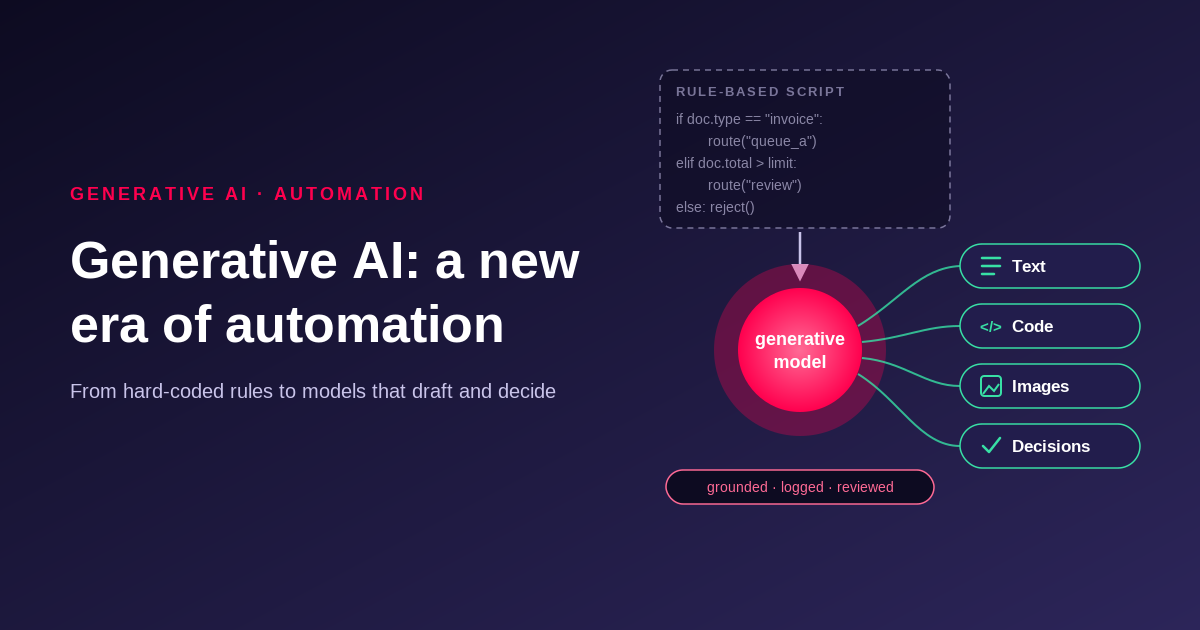
Generative AI is shifting automation from rule-based scripts to systems that can produce text, code, images, and decisions from patterns in data. For developers in manufacturing, supermarkets, banking, education, healthtech, fintech and tax returns, that means moving from hard-coded workflows to assistants that can draft, summarize, classify and recommend — with the same operational constraints those industries already live with: accuracy, auditability, latency, and cost.
What is Generative AI?
In practice, generative AI refers to models that generate new outputs conditioned on a prompt or context. The subject means the same thing across the sectors you operate in: a capability to synthesize content or actions rather than only retrieve it. The implications differ by domain.
In manufacturing, that is a work instruction generator or anomaly report summarizer. In supermarkets, it is product description generation and demand-copy drafting. In banking, fintech and tax returns, it is draft explanations of policy or client-facing summaries that must be traceable. In education and healthtech, it is tutoring content and clinical note assistance where accuracy and safety are non-negotiable.
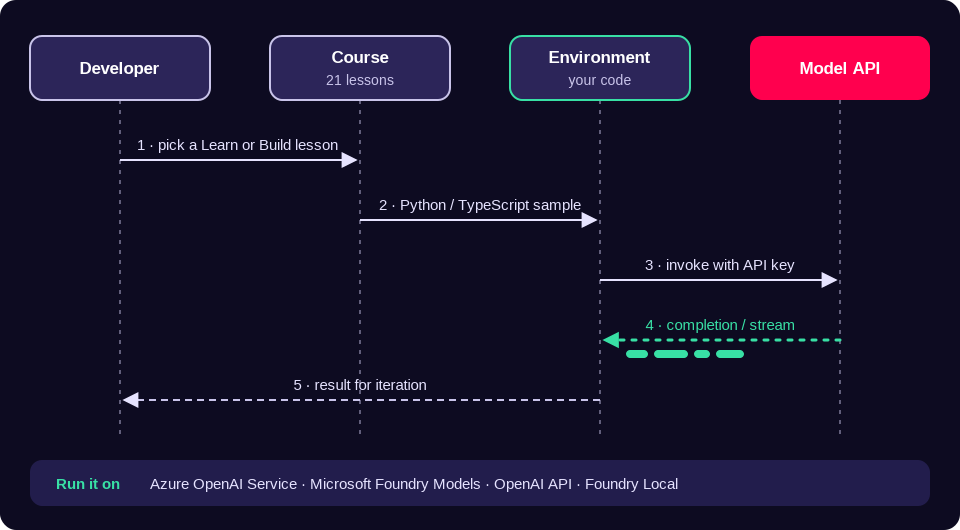
Developers new to the field should start with structured learning. The Microsoft Generative AI for Beginners course has 21 lessons [1]. Lessons are labeled either 'Learn' or 'Build' lessons [1]. To run the code, you can use Azure OpenAI Service, Microsoft Foundry Models, OpenAI API, or Foundry Local [1]. Each lesson includes a short video introduction, a written lesson, Python and TypeScript code samples, and links to extra resources [1].
Getting Started Architecture
Applications and Benefits
Benefits are broadly similar across industries, but the value shows up in different operational metrics.
Manufacturing gains faster documentation and maintenance support. Supermarkets gain faster catalog updates and personalized offer copy. Banking, fintech and tax returns gain draft explanations and client Q&A with consistent tone. Education gains adaptive practice material. HealthTech gains structured summarization of notes, with human review remaining in place.
A practical developer concern is building robust natural language powered applications. Axflow is a collection of modules for building robust natural language powered applications [2]. These modules can be adopted incrementally, thus providing a modular and scalable solution [2]. Axflow includes a zero-dependency, modular SDK for building robust natural language applications [2]. As a foundational framework, Axflow empowers developers to build higher-level TypeScript AI features and products seamlessly [2].
For retrieval-augmented generation, model choice matters. Titan Text Premier is optimized for high-quality RAG and agent-based applications and customization through fine-tuning while incorporating responsible artificial intelligence practices [3]. Titan Text Premier can be fine-tuned with your own data in Amazon Bedrock to increase model accuracy [3].
When you need vector search close to operational data, database support helps. AlloyDB AI provides built-in, end-to-end support for vector embeddings [4]. AlloyDB AI allows users to easily transform their data into vector embeddings with a simple SQL function [4]. These models can be used to automatically create embeddings via inferencing in generated columns and to generate embeddings on-the-fly in response to user inputs [4]. AlloyDB AI runs vector queries up to 10x faster compared to standard PostgreSQL when using the IVFFlat index [4].
Challenges and Limitations
The same capability that creates value creates risk. The challenges are common across your sectors, with sector-specific consequences.
Accuracy and hallucination affect tax returns and banking disclosures where an error has regulatory cost. In manufacturing, a hallucinated maintenance step can cause downtime. In healthtech, a fabricated summary can affect care. In supermarkets and education, bad copy erodes trust.
Detecting AI-generated content is an active problem. Pangram is a detector of AI content, at least in Wikipedia articles [5]. Based on our experiences in the fall term, we have high confidence in Pangram as a detector of AI content, at least in Wikipedia articles. In practice, participants did not use AI tools to draft text for their assignments [5]. Critically, no participants reported using AI tools to draft text for their assignments.
Operational concerns include latency, cost, and observability. Amazon Bedrock emits data points to CloudWatch using the AWS/Bedrock namespace to track common metrics such as InputTokenCount, OutputTokenCount, InvocationLatency, and Invocations [6]. Amazon Bedrock's InvokeModelWithResponseStream API allows users to run inference using the provided input and stream the response as the model generates the output [6]. Security posture is foundational: Amazon Bedrock provides data encryption in transit with a minimum of TLS 1.2 encryption and data at rest is encrypted with AES-256 using AWS KMS managed data encryption keys [6].
Getting Started with Generative AI
A pragmatic path for developers new to the field:
- Learn concepts before building. Use a course with Learn/Build separation so you can alternate theory and code.
- Pick one environment and stick with it. The Microsoft beginners course supports Azure OpenAI Service, Microsoft Foundry Models, OpenAI API, or Foundry Local [1].
- Start with retrieval, not generation alone. Ground outputs in your own data.
- Instrument from day one. Track tokens, latency and invocations.
Minimal Python starter pattern using an API client:
# pseudo example - adapt to your chosen SDK
client = get_client(provider="azure_openai") # or openai, foundry
response = client.chat.completions.create(
  model="gpt-4o-mini",
  messages=[{"role":"user","content":"Summarize this work order in 3 bullet points"}],
  temperature=0.2
)
print(response.choices.message.content)
Keep prompts explicit, constrain output format, and log prompts and responses for audit.
Real-World Examples and Use Cases
Across manufacturing, supermarkets, banking, education, healthtech, fintech and tax returns, the patterns repeat with different data.
| Use Case | Where It Appears | Developer Concern |
|---|---|---|
| Text Generation | Product descriptions, policy summaries, work instructions | Consistency, brand voice, audit trail |
| Recommendation Systems | Shelf offers, course pathways, loan products | Latency, explainability |
| Speech Synthesis | IVR responses, training narration | Voice fidelity, accessibility |
| Image Generation | Mockups, training visuals | Brand safety, rights |
In manufacturing, a Build lesson approach can prototype a maintenance assistant that retrieves from a knowledge base and streams answers. In supermarkets, the same pattern powers a catalog assistant that writes SEO-friendly descriptions from structured product attributes. In banking and tax returns, the assistant drafts client explanations from retrieved policy excerpts, with human review gates. In education and healthtech, the assistant generates practice questions or note summaries, always with clear provenance.
The technology is the same; the constraints are local. Start small, measure tokens and latency, enforce retrieval grounding, and keep human review where the cost of error is high.
Summary and Conclusion
Generative AI offers faster drafting, summarization and personalization across manufacturing, retail, finance and regulated sectors, with developer-level benefits from modular SDKs like Axflow, RAG-optimized models like Titan Text Premier, and vector-capable databases like AlloyDB AI. The challenges are accuracy and hallucination, observability, cost and latency, and security, all of which require retrieval grounding, instrumentation via CloudWatch metrics, streaming APIs and encryption, and human-in-the-loop review for high-risk outputs.
References
- Generative AI for Beginners — microsoft.github.io
- axflow/axflow — github.com (2 March 2024)
- Build RAG and agent-based generative AI applications with new Amazon Titan Text Premier model, available in Amazon Bedrock | Amazon Web Services — aws.amazon.com (7 May 2024)
- Helping developers build Gen AI apps with Google Cloud PostgreSQL databases — cloud.google.com (29 August 2023)
- Generative AI and Wikipedia editing: What we learned in 2025 — wikiedu.org
- Amazon Bedrock Is Now Generally Available – Build and Scale Generative AI Applications with Foundation Models | Amazon Web Services — aws.amazon.com (28 September 2023)