Der Shop ist online

Wir bauen Workstation AI-Maschinen für Websites, KI-Agenten und LLM-Training – online konfigurieren und kaufen.

Händlerpreise erhalten
KI-Produkte
KI-LabsOpenAI-AgentenClaude-AgentenGrok-BotWorkstation AI-natives CRMMarketingAlle Produkte
KI-Lösungen
Angewandte KIKI-AgentenGenerative KIKI-AutomatisierungKI-WeiterbildungKI-Pakete für KMUEnterprise AI LabKI-WorkstationsNVIDIA-Hardware & -SoftwareNVIDIA Accelerated ComputingPrivate KIGPU-Private-CloudGPU-ClusterEdge-KIKI nach Branche
KI-Services
PlattformmodernisierungDigital EngineeringDatengrundlagen & KIAutonomer BetriebKI-BeratungDevOps-AutomatisierungCybersicherheitSoftwareentwicklungAgentenentwicklungMLOps-EinrichtungGPU-LeasingGPU-Private-Cloud
Über uns
UnternehmenUnsere GeschichtePartnerKundengeschichten
KI-Rechenzentren
KI-RechenzentrenGPU-Private-CloudGPU-ClusterGPU-Leasing
KI-EinblickeJev-ReiheBenchmark LabModellauswahl
Technische Hinweise
Dokumentation
Linux-BetriebssystemeUbuntuRed Hat Enterprise LinuxSUSE LinuxAlpine LinuxDebian, Rocky & AlmaLinux
KI-Cloud-PlattformenAWS & Amazon BedrockGoogle Cloud & Vertex AIMicrosoft Azure & AI FoundryGPU-Clouds & Marktplätze
Private KI-RechenzentrenFür AnwaltskanzleienFür Steuer- und WirtschaftsprüfungskanzleienOn-Premises-PlattformenVollständig abgesicherte Cloud
ToolsRing PromoterJobshout
News
Blog
KontaktAnmelden

KI-Workstations, Multi-Agenten-KI-Software, GPU-Infrastruktur und intelligente Agentenlösungen für moderne Unternehmen.

Kontakt

KI-Lösungen

Angewandte KIKI-AgentenGenerative KIKI-AutomatisierungKI-WeiterbildungKI-Pakete für KMUEnterprise AI LabKI nach Branche

Produkte

Alle ProdukteWorkstation AI-natives CRM & ERPMarketingOpenAI-AgentenRing PromoterJobshout

Unternehmen

Über unsUnternehmenKI-RechenzentrenWarum WorkstationPartnerKundengeschichtenPreiseKontaktTenthMatrix

Ressourcen

KI-EinblickeTechnische HinweiseDokumentationLinux-BetriebssystemeKI-Cloud-PlattformenPrivate KI-RechenzentrenBlogSucheSitemap
Büro Belgien
Workstation SRL, Rue Vanderkindere 34, 1180 Uccle, BrusselsBE 0751.518.683Mo – Fr: 9:00 – 18:00 Uhr MEZ
+32 492 45 67 46
Hauptsitz Großbritannien
77-79 Marlowes, Hemel Hempstead HP1 1LFAnfahrt – Ausfahrt 20 der M25 (Outer London)Handelsregisternr.: 11641870Mo – Fr: 9:00 – 18:00 Uhr GMT
+44 7515 356 146
Büro Indien
#159 Sector 9, Pocket 1, DDA Flats, 110077 Dwarka, New Delhi
+91 98881 98841
Büro Taiwan
3F, No. 2-4, Aisi Rd., Ren'ai Dist., Keelung City 200, Taiwan基隆市仁愛區愛四路2之4號3樓Mo – Fr: 9:00 – 18:00 Uhr Taiwan-Zeit (GMT+8)
+886 926 892 701+32 492 45 67 46
Büro Estland
Aleksander Puškini tn 30-25, 20306 Narva, EstoniaMo - Fr: 9:00 - 18:00 Uhr estnischer Zeit (EET)
+32 492 45 67 46

© 2026 Workstation AI. Alle Rechte vorbehalten.

DatenschutzDatenlöschungCookiesNutzungsbedingungenWebsite-Sitemap

NVIDIA, das NVIDIA-Logo, RTX, RTX PRO, Blackwell, CUDA, NVLink, MGX, Omniverse, Spectrum-X, Quantum, BlueField, DGX und HGX sind Marken und/oder eingetragene Marken der NVIDIA Corporation in den USA und anderen Ländern. AMD, das AMD-Arrow-Logo, EPYC, Instinct, Ryzen und Threadripper sind Marken von Advanced Micro Devices, Inc. Dell und PowerEdge sind Marken der Dell Inc. oder ihrer Tochtergesellschaften. Intel und Xeon sind Marken der Intel Corporation oder ihrer Tochtergesellschaften. AMAX, AceleMax und LiquidMax sind Marken der AMAX Engineering Corporation. Alle anderen Produktnamen, Logos und Marken sind Eigentum ihrer jeweiligen Inhaber. Wir verwenden sie ausschließlich, um die Produkte zu kennzeichnen, die wir beschreiben, liefern oder unterstützen; ihre Verwendung bedeutet nicht, dass ihre Inhaber uns empfehlen.

Loading blog...

Startseite / Blogs
DatabaseKubernetesDevOpsSREObservability

Couchbase upgrades with CAO pause gates: a support-friendly overview

Controlled rolling upgrade using CAO native pause gates, health checks, and XDCR-aware monitoring
Balinder Walia22. April 20262 min read
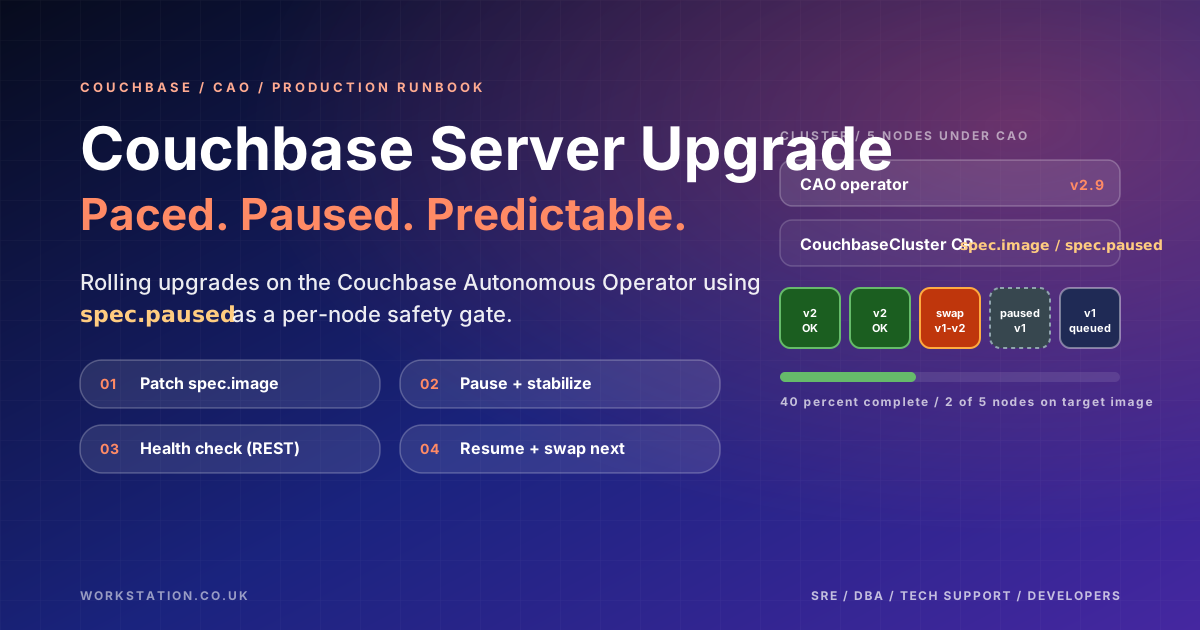
Couchbase Server upgrade runbook cover

If you support a Couchbase platform (or you’re the person who gets paged when it doesn’t behave), upgrades can feel like a choice between “hands-off and hope” and “manual and risky”. This post captures a pragmatic middle ground: a controlled rolling upgrade for Couchbase Server running under the Couchbase Autonomous Operator (CAO), paced by CAO’s native spec.paused field.

Who this is for

  • Tech Support / incident responders: what “normal” looks like during swap-rebalance and what to treat as a red flag.
  • SRE / platform engineers: repeatable procedure with preflight checks, soak gates, and rollback triggers.
  • Database engineers: rebalance expectations, XDCR behaviour, and post-upgrade validation.
  • Developers: what your platform is doing during the maintenance window (and what you should alert on).

Typical CAO-managed topology (conceptual)

The diagram below is a mental map for the runbook: where the operator sits, what the CouchbaseCluster CR controls, and what signals you should correlate during the upgrade.
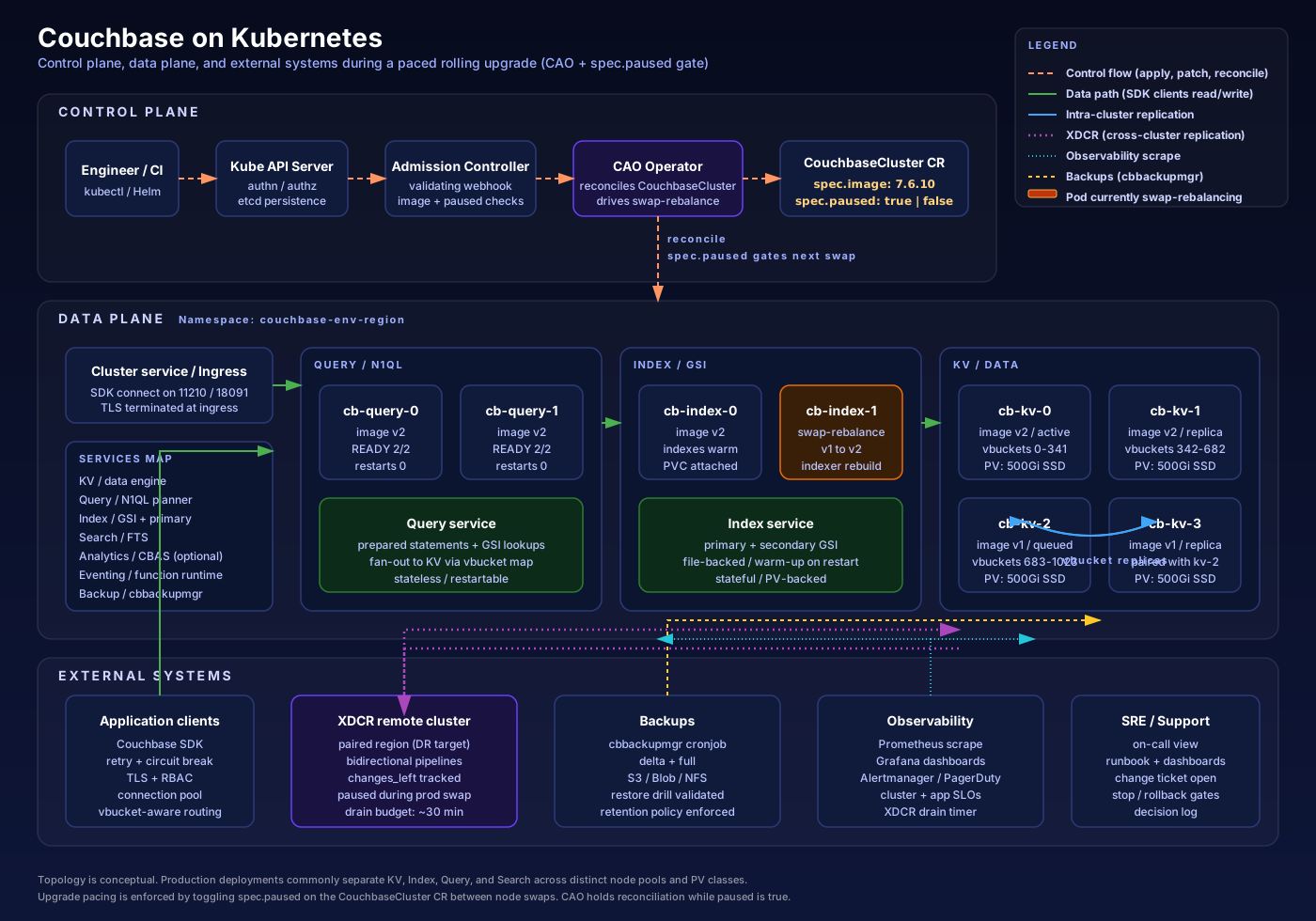
Typical Couchbase on AKS topology

The big idea: pace CAO with a pause gate

CAO performs a rolling upgrade via swap-rebalance. The runbook adds a deliberate safety gate: pause reconcile between nodes, stabilize, verify health, then resume. That way, if node N misbehaves after its swap, you catch it before node N+1 starts.
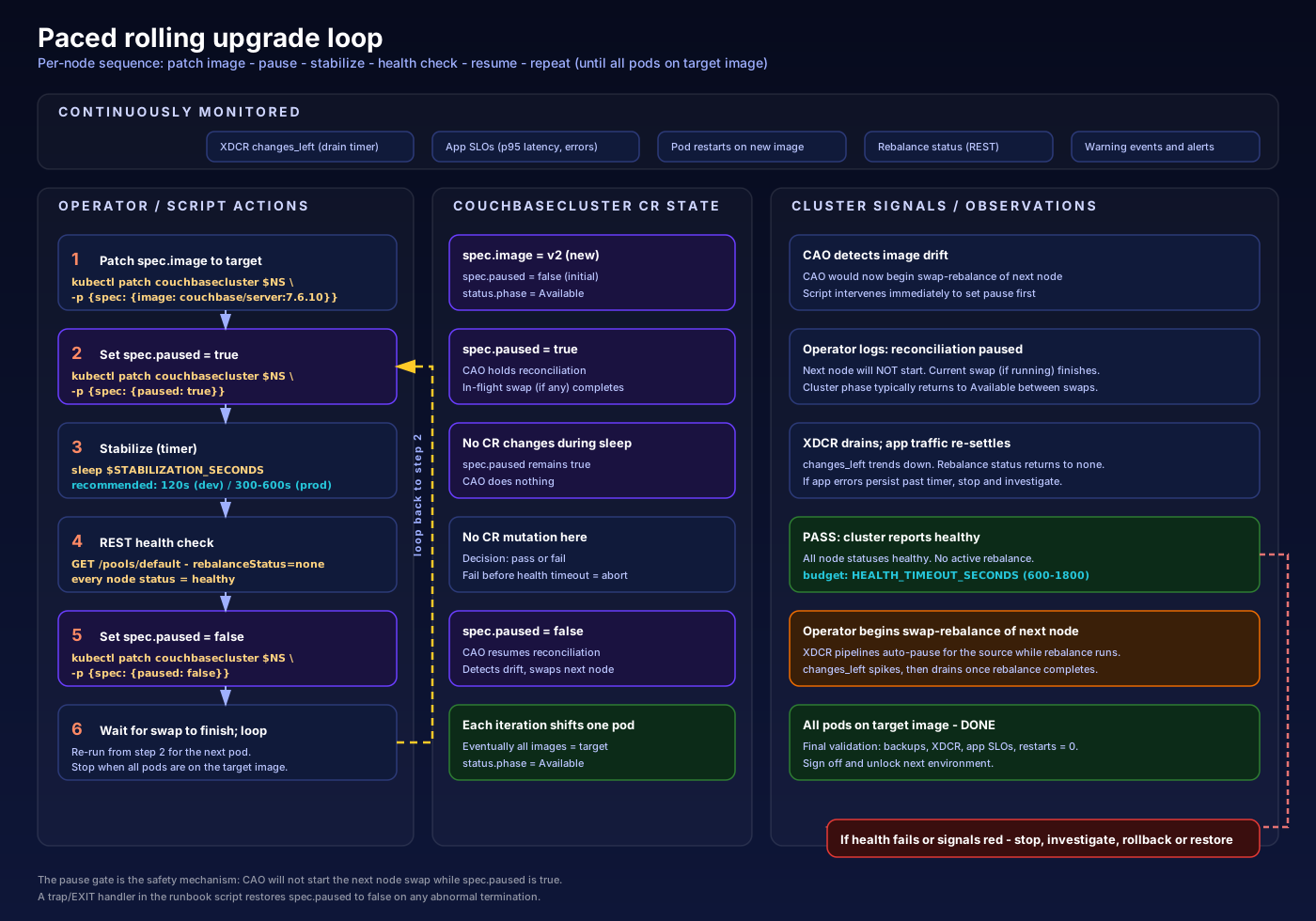
Paced upgrade loop

Why the pause gate is worth it

  • Fewer surprises: isolate symptoms to a single node change.
  • Cleaner signals: correlate latency, error rate, rebalance state, and XDCR lag to one swap.
  • Safer rollouts: stop the “conveyor belt” quickly by holding spec.paused=true while you investigate.

What “good” looks like during the upgrade

  • Pod images: old → new progressively; ideally one swap at a time.
  • Cluster phase: often returns to Available between swaps; brief transitions during rebalance are expected.
  • XDCR (if enabled): changes_left rises during rebalance, then drains during stabilization.
  • Restarts: new pods start at RESTARTS=0. Any increase is a signal to pause and investigate.

Preflight checks that save you later

Before you touch anything, make sure the cluster is green (no active rebalance, no warning events), backups are current and restorable, and you’ve recorded the rollback image tag. Decide your XDCR strategy up-front: disable during upgrade for a quieter signal in production, keep running in pre-prod to exercise real behaviour, or use a third standby cluster for strategic cutovers.

Rollback reality check

The uncomfortable truth that mature runbooks say out loud: rollback is only cleanly possible while at least one node remains on the old version. Once every pod has been swapped and the cluster has fully rebalanced, “downgrade” can become “restore from backup”. That’s why pacing matters: it keeps the rollback window open longer.

Next steps

  • Read the full operational guide: Couchbase Server rolling upgrade under CAO (paced + pause gate)
  • Related background: Couchbase high availability in production (XDCR + Kubernetes operator)