Building Confidence Through SRE-based Training

The Importance of Operational Confidence
For developers working in Manufacturing, Supermarkets, Banking, Education, HealthTech, FinTech and Tax Returns, production incidents carry sector-specific consequences. A checkout outage during peak trading, a payment reconciliation delay, a patient record sync failure, or a tax filing window freeze all translate directly to revenue loss, compliance risk, or safety impact.
Operational confidence is not the same as coding proficiency. There’s this implicit assumption that coding proficiency translates seamlessly to operational confidence, but it doesn’t. [1]
In these industries, confidence means the team can detect, diagnose, and remediate production issues within defined SLOs without escalating every alert. It means change can be shipped with predictable blast radius. It means on-call engineers feel equipped rather than anxious.
Culture is not some grand mindset you need to shift. It’s much more tactical. You can change your culture by changing what people do every day. [1]
How SRE-based Training Can Help
SRE-based training is deliberate practice of production operations for developers, platform engineers and SREs. It moves learning from theory to rehearsed behavior: observe, hypothesize, test, mitigate, postmortem, with measurable outcomes tied to reliability.
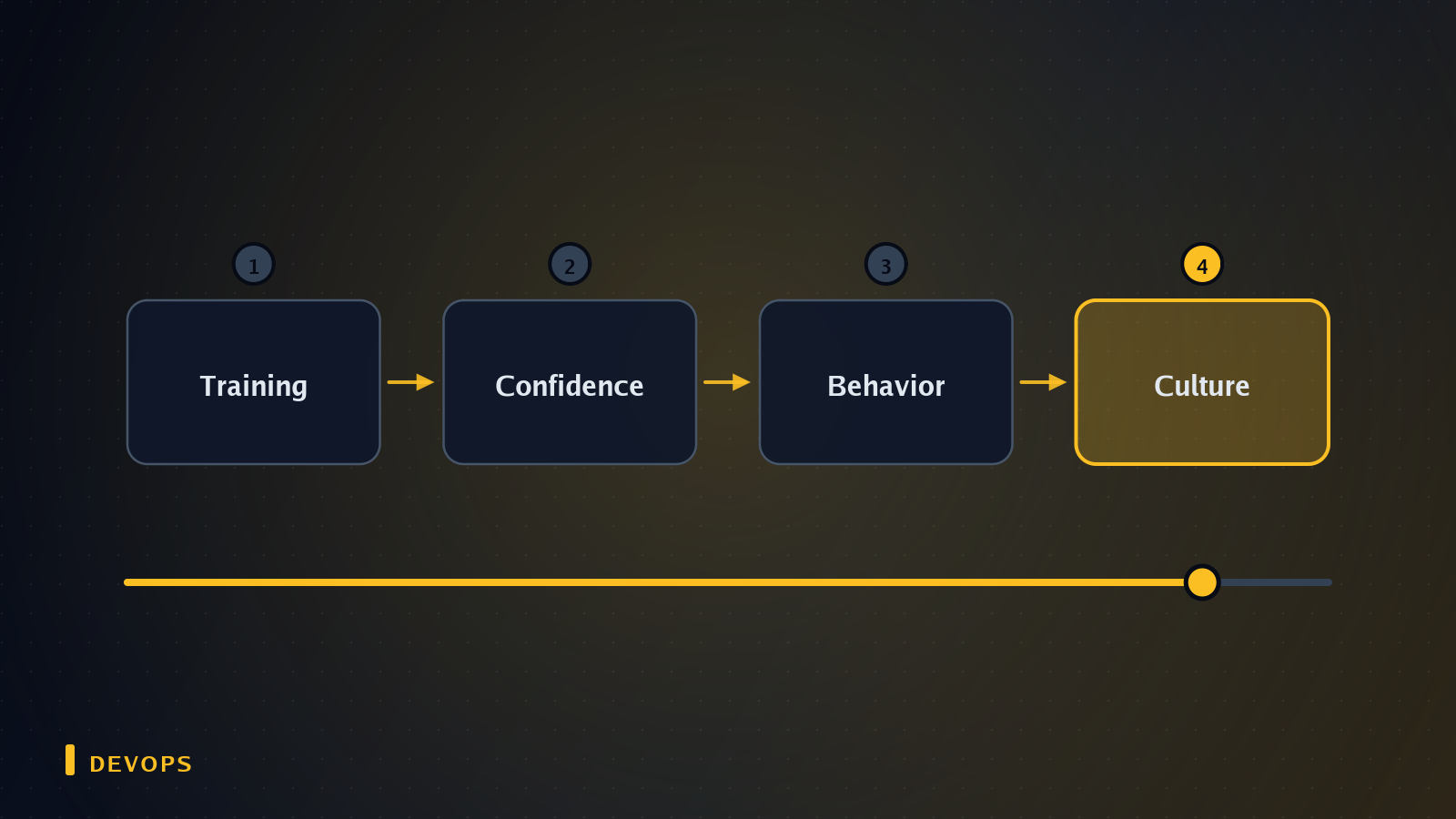
SRE-based training builds the repeatable behaviors that make production work reliable. Training can act as a confidence engine, turning repeated behaviors into habits and culture. [1]
The model is straightforward: Learning drives confidence, confidence drives behavior, and behavior repeated over time drives culture. [1]
For a developer audience, this means training is not about memorizing SLO formulas. It is about rehearsing the operational loop: observe → hypothesize → test → mitigate → postmortem. When teams practice that loop in safe environments, they stop treating production as mysterious and start treating it as a system they can influence.
Training also closes the gap between building and running. Engineers learn to write for operability: emit the right signals, make failures visible, and design for rollback. In HealthTech and Banking, that directly supports auditability and regulatory evidence. In Manufacturing and Supermarkets, it supports uptime of line-control and inventory systems where downtime is measured in lost throughput.
Training Loop
Implementing SRE-based Training in Your Organization
Implementation works best as a deliberate program, not ad-hoc workshops.
Identify Current Gaps Map where incidents stall: detection latency, triage confusion, missing runbooks, or fear of production changes. Interview on-call engineers and review recent postmortems. In Tax Returns, gaps often appear around peak filing windows. In FinTech, gaps often appear around payment retries and idempotency.
Develop a Training Plan Define measurable outcomes, e.g., mean time to detect <5 minutes, or 100% of critical services have runbooks with validated playbooks. Align modules to roles: developers, platform engineers, SREs. A training plan should include scope, learning objectives per role, lab environments, schedule for game days, success metrics, and review cadence. It should specify what is practiced, how fidelity is maintained, and how results feed back into runbooks and SLOs.
Implement Training Use a mix of hands-on labs, game days, and real incident reviews. A minimal lab scaffold can look like this:
# example game-day checklist
1. inject latency in staging service
2. require team to detect via dashboard
3. run runbook steps in order
4. execute rollback
5. write blameless postmortem
Make the environment realistic. If you use Kubernetes, note that Cluster API is infrastructure-agnostic. [2] Cluster API has a pluggable model for adding new providers as needed. [2] That agnosticism matters for Manufacturing and Education teams running mixed on-prem and cloud clusters, because training scenarios can be portable across providers.
Cluster API is a Kubernetes project for declarative, provider-agnostic lifecycle management of Kubernetes clusters. Infrastructure-agnostic means the same API can target different underlying infrastructure. Pluggable model means new infrastructure providers can be added without changing core control plane logic.
Monitor Progress Track repeat behaviors: runbook usage, successful canary rollouts, reduction in repeat incidents. Adjust the training plan based on data, not anecdotes. Success is measured with leading indicators such as drill completion rate and time to first meaningful action, and lagging indicators such as MTTD, MTTR, change failure rate, and on-call sentiment.
Benefits and Challenges of SRE-based Training
Benefits are consistent across the sectors listed, because production reliability is a shared concern.
A table of common trade-offs helps decide where to invest first:
| Focus Area | What Training Improves | Typical Risk if Skipped |
|---|---|---|
| Observability | Faster detection and scoping | Extended outages, especially in Banking and HealthTech |
| Incident Response | Clear roles, faster mitigation | Escalation fatigue, longer MTTR |
| Change Management | Safe deploys, canary practice | Failed releases during peak trading or filing windows |
| Postmortem Culture | Learning from failures | Repeated incidents, compliance exposure |
Sector-specific benefits:
- Banking and FinTech: safer payment retries, auditable incident response, reduced regulatory exposure.
- HealthTech: reliable patient data sync, faster recovery with safety impact.
- Manufacturing and Supermarkets: uptime of line-control and inventory systems, reduced lost throughput.
- Education and Tax Returns: stable access during enrollment and filing windows, predictable support load.
Challenges are also universal. Time is the primary constraint. Teams in Supermarkets and Manufacturing often have limited release windows. Banking and FinTech face change-control boards. Education and HealthTech face strict access controls for production data.
Another challenge is provider risk. Redundancy is the name of the game, and any single-point-of-failure (in this case, a hosting company) is a bad idea. [3] The provider promise problem is real: Digital Ocean promised IPv6 support and the ability to run custom kernels several years before they provided this support. [3] Training should include provider failure scenarios, not just application failures.
Canary analysis is a controlled rollout technique where a small percentage of traffic is sent to a new version to compare metrics against a stable baseline. Kayenta is an open source canary analysis tool from Netflix. The hardest part of developing a canary configuration is adjusting the metrics and the weights you give them, and debugging Kayenta queries against your monitoring system. [4] You need to be able to run those queries manually. [4] You need at least 50 pieces of time-series data per metric for the statistical analysis to be relevant. [4] Those points reinforce why training must be hands-on, not slide-based.
Real-World Examples and Case Studies
Production-ready culture shows up as daily habits, not heroic fixes. Production-ready culture means teams can reliably detect, diagnose, remediate, and learn from incidents within defined SLOs, ship changes with predictable blast radius, and maintain auditability. It is built by repeated operational practice, not by documentation alone.
In FinTech, one team introduced weekly 45-minute game days focused on payment idempotency failures. The specific problem was duplicate charges during retry storms after transient network partitions. After eight weeks, MTTR for duplicate-charge alerts dropped and engineers reported higher confidence during on-call. The training acted as a confidence engine, turning repeated behaviors into habits and culture. [1]
In HealthTech, a team used SRE-based training to standardize runbooks for patient data sync jobs. The challenge was inconsistent triage across shifts leading to data lag. Learning drove confidence, confidence drove behavior, and behavior repeated over time drove culture. [1] Postmortems became shorter and more actionable because the diagnostic steps were rehearsed.
In Manufacturing, an edge-compute team practiced failover drills using Cluster API’s infrastructure-agnostic model. [2] Because Cluster API has a pluggable model for adding new providers as needed. [2] they could rehearse the same control-plane failure on both on-prem and cloud without rebuilding scenarios. The problem addressed was single-site control plane loss affecting production line controllers.
In Tax Returns, a team trained on canary analysis before peak filing season. They learned to adjust metrics and weights and to debug queries against monitoring manually, aligning with the reality that the hardest part of developing a canary configuration is adjusting the metrics and the weights you give them, and debugging Kayenta queries against your monitoring system. [4] They also ensured queries could be run manually. [4] and that they collected at least 50 pieces of time-series data per metric for the statistical analysis to be relevant. [4] The challenge was avoiding false positives that would block a critical tax calculation rollout.
These examples share a pattern: small, repeatable practice, measured outcomes, and explicit connection to business risk. SRE-1 is a 27B model for production investigations. [5] Claude Code is an agentic coding tool available in the terminal, IDE, desktop app, and browser. [6] An agentic coding tool is an AI assistant that can autonomously plan and execute multi-step coding tasks. Claude Code has a user interface for contextual feedback and code snippet feedback. [6] Contextual feedback refers to in-workflow signals that help the model understand intent in current code context. Tools like these can accelerate lab creation, but they do not replace the habit loop.
The subject means the same thing across Manufacturing, Supermarkets, Banking, Education, HealthTech, FinTech and Tax Returns: teams that rehearse operations become calmer under load, and calmer teams make fewer mistakes. Culture is tactical. Change what people do every day, and confidence follows.
References
- Building a Production-Ready Culture and Skills Through SRE-based Training — infoq.com
- Kubernetes Cluster API reaches production readiness with version 1.0 | CNCF — cncf.io (6 October 2021)
- In 2016, is DigitalOcean safe to use for production? — news.ycombinator.com (1 August 2016)
- Canary analysis: Lessons learned and best practices from Google and Waze — cloud.google.com (15 January 2019)
- SRE-1: Dominating the Pareto Frontier of Production Investigations with a 27B Model — resolve.ai (18 November 2026)
- Best practices for Claude Code - Claude Code Docs — anthropic.com (19 April 2025)