Generative AI Boosts Software Engineering Productivity

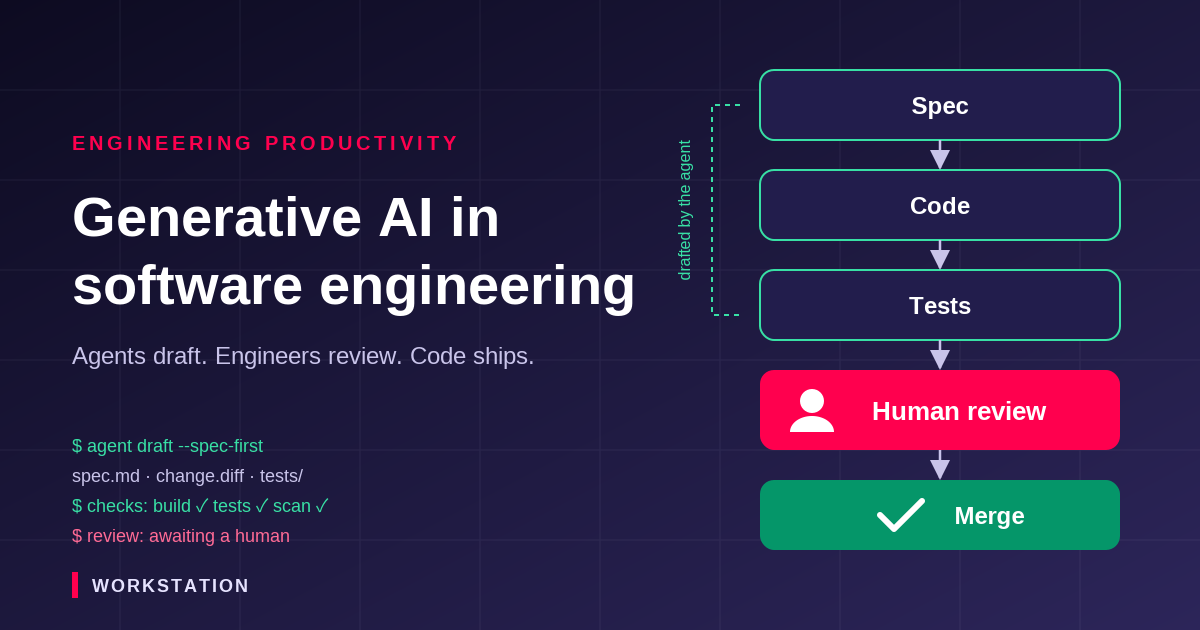
Generative AI is changing how software is written, tested and delivered, but the gains are not where most teams first look. They come from agents that draft specs, code and tests for an engineer to review, not from putting a model in the path of every request. Here is where it helps, where it doesn't, and how to run a pilot that proves it in your own team.
Interactive version: sort real tasks into build time and run time, step through the agent workflow, and size a pilot with your own numbers.
Generative AI in software engineering: what has actually changed
For engineering teams in manufacturing, retail, banking, education, health tech, fintech and tax, the shift is less about replacing developers and more about changing what they do each day: less scaffolding and boilerplate, more specifying, reviewing and validating.
The tools are large language models trained on code and tuned on how engineers actually work. Google's research team, describing its own internal tooling, says that "high quality data from activities of Google engineers across software tools, including interactions with our features, is essential for our model quality", and that "quick iterations with online A/B experiments are key, as offline metrics are often only rough proxies of user value" [1]. Both points apply to any team: the model is only as good as the examples it learns from, and a benchmark score is not the same as time saved in your codebase.
Adoption is broad. Gartner predicts that 75% of enterprise software engineers will use AI code assistants by 2028 [3]. The tools have moved quickly too. GitHub's Copilot Workspace, which turned an issue into a plan, a set of changes and a runnable result that a developer could edit, re-run or re-order step by step [3], ended its technical preview on 30 May 2025; GitHub Next moved the idea on to agents that open pull requests [7]. The workflow it showed is now the common pattern.
Build time and run time are different jobs
The most useful distinction in the sources comes from an engineering post at Commonwealth Bank of Australia [2]. A build-time agent works offline, before anything ships: it writes the spec, the code and the tests, and a person reviews them. A run-time agent sits inside the running system and acts on live requests.
Build-time agents are where the gains are. The post argues that they "can provide significant increases in end-to-end delivery by replacing manual delivery with AI generated product and engineering specs, code, and tests" [2]. A developer describes a requirement, for example a supermarket stock reconciliation job or a validation rule for a tax return, and gets a draft spec, a first implementation and starter tests to review.
Run-time agents work under harder constraints. As the same post puts it: "Code is fast. No matter what we do, AI agents will always be slower to solve a deterministic problem than a coded algorithm" [2]. A payment authorisation in a bank or an alert in a patient-monitoring service needs a fast, repeatable answer, so the hot path stays as ordinary code. An agent can help write that code; it should not replace it.

A practical workflow, step by step
This is the loop most teams settle on. It replaces the original sequence diagram with the checks that make it safe to use in a regulated business.
- Describe the requirement. Write the task as you would for a new colleague: what, why, constraints and what "done" means (for example, test coverage, an audit log entry, a performance budget).
- Agent reads the context. It reads the repository, related issues and existing tests. Give it the conventions file and the module boundaries; do not give it production secrets or customer data.
- Agent drafts spec, change and tests. Ask for the spec first. If the spec is wrong, the code will be too, and a spec is quicker to review.
- Automated checks run. Build, unit tests, linters, security and licence scanning, exactly as for a human change.
- A person reviews. The engineer approves, edits or re-prompts. They remain responsible for correctness, security and regulatory fit.
- Merge and record. Merge through the normal pipeline, and record that the change was AI-assisted so you can measure it later.

A minimal request to a build-time agent, for a UK self-assessment rule, looks like this:
Repo: tax_engine/
Task: Reject 2025-26 self-assessment returns with a missing or malformed
      National Insurance number for the taxpayer.
Constraints: fail fast with a clear error code; write an audit event;
             unit-test coverage of the new rule above 90%.
Output first: spec.md (rule, inputs, error codes, edge cases).
Then: the change as a diff, and tests/ for the rule.
Do not: change public API signatures or touch other rules.
The agent returns the artefacts for review. Nothing it produces reaches production without the same checks a human change would pass.
How much autonomy, and where
Teams usually move up a ladder of trust rather than jumping straight to autonomous agents. Google reports that "ML-based automation of larger-scale tasks from diagnosis of an issue to landing a fix has begun to show initial evidence of feasibility" [1], which is a careful way of saying: early, promising, not yet routine.

| Sector | Good first use | What must stay with people |
|---|---|---|
| Manufacturing | Integration code between ERP and shop-floor systems, such as a Modbus parser with unit tests from a written spec | Safety logic and traceability rules |
| Supermarkets and retail | ETL scripts and data-quality checks, such as a nightly reconciliation of till transactions against warehouse deliveries | Edge cases such as returns, voids and promotions |
| Banking and fintech | API clients with retries, idempotency and audit logging; test fixtures and documentation | Checking against PCI DSS and internal control policies |
| Health tech | Boilerplate for services and tests, built and evaluated on de-identified data | Clinical safety review of anything that affects care |
| Education and tax | Validation rules and report generators with full test suites | Audit trails and explainable decisions |
People and skills
The human role does not go away; it changes. The CommBank post notes a learning curve: "it takes several weeks for engineers to figure out how to prompt effectively and determine when to trust the output versus when to step in", and argues there will always be a need for experienced engineers "to develop, train, validate and optimise these agentic coding systems" [2]. Plan for that time in any pilot, and expect early results to understate the steady state.
The work shifts towards writing good specifications, reviewing changes you did not type, and owning the result. That needs training and clear ownership: someone is accountable for every merged change, whoever or whatever drafted it.
Hardware for running models in-house
Teams that build internal assistants, or that cannot send code to a hosted model for data-residency reasons, need their own hardware. Two examples from the sources show the range.
At the small end, NVIDIA's DGX Spark is a desktop AI system with 128 GB of coherent unified memory [5][6], a 10 GbE port and two QSFP ports on a ConnectX-7 network card at up to 200 Gbps, so two units can be clustered [5][6]. It ships with NVIDIA DGX OS, based on Ubuntu [5], and LMSYS reports it can handle models of up to 405 billion parameters in FP4 [6]. For a team evaluating models or running a private coding assistant, that is enough memory for large models without a server room.
At the edge, SiFive's RISC-V cores target AI and machine-learning work. The P870 is a 64-bit, six-wide out-of-order core that follows the RVA23 profile, with a reported 50% single-thread uplift over its predecessor on SPECint2006; the X390 vector core reports four times the vector compute and sustained data bandwidth [4]. These matter more for embedded inference than for developer tooling.
| Option | Typical use | Strength | Constraint |
|---|---|---|---|
| NVIDIA DGX Spark | Developer workstation, private assistant, small cluster | 128 GB unified memory, 200 Gbps clustering | Cost and power per seat |
| RISC-V P870 / X390 | Edge and embedded inference | Open instruction set, vector bandwidth gains | Software ecosystem still maturing |
For regulated work in banking, health and tax, local hardware can make compliance simpler because code and data never leave your control.
Risks and common mistakes
- Measuring the wrong thing. Lines of code and accepted suggestions are easy to count and say little. Measure lead time from ticket to production, review time and escaped defects.
- Skipping the review. Generated code can be plausible and wrong. Treat it like a change from a new joiner: read it, run it, test it.
- Agents on the hot path. Putting a model in a latency-critical, deterministic path makes it slower and less predictable [2].
- Leaking data. Do not paste customer data or secrets into prompts; use de-identified data and a private or approved model.
- No audit trail. In regulated sectors, record which changes were AI-assisted and who approved them.
- Expecting results in week one. The learning curve is real and takes weeks [2].
What to do this week
- Pick one team and one kind of task that is mostly boilerplate, such as tests, API clients or data checks.
- Record a baseline: lead time and review time for the last ten similar changes.
- Write a one-page rule: which models are approved, what data may go into prompts, and that every AI-assisted change gets human review.
- Run the six-step workflow above for four to six weeks, tagging each AI-assisted pull request.
- Compare against the baseline, including review effort, and decide whether to extend, adjust or stop.
Generative AI boosts productivity when it is treated as an accelerator for experienced engineers rather than a replacement for them. Start small at build time, keep deterministic code where it belongs, and let your own measurements decide how far to go. If you want to run that pilot on your own hardware, or connect agents to your systems safely, see our work on AI agents.
References
- AI in software engineering at Google: Progress and the path ahead, Google Research (6 June 2024)
- The Evolution of AI Software Engineering, CommBank Technology on Medium (23 August 2025)
- Copilot Workspace is GitHub's take on AI-powered software engineering, TechCrunch (29 April 2024)
- SiFive Rolls Out RISC-V Cores Aimed at Generative AI and ML, All About Circuits
- The NVIDIA DGX Spark is a Tiny 128GB AI Mini PC Made for Scale-Out Clustering, ServeTheHome (1 April 2025)
- NVIDIA DGX Spark In-Depth Review: A New Standard for Local AI Inference, LMSYS Org (14 October 2025)
- Copilot Workspace, GitHub Next (technical preview sunset 30 May 2025)